This journey, started in 2022, aims at responsible management that contributes to the Group’s sustainable growth and generates a positive impact on stakeholders.
ESG Path
Our company tackles this challenge with enthusiasm, implementing sustainable business practices based on ESG (environmental, social, and governance) criteria.
With this in mind, we have begun a process of alignment with the CSRD, the new European directive governing sustainability reporting to ensure greater transparency, comparability, and reliability of companies’ ESG data.
2022
Launch of the ESG journey
Context analysis
First double materiality assessment
2023
Stakeholder engagement
Definition of material topics
First Sustainability Plan
2024-2025
Integration into business processes
Progressive alignment with the ESRS
Consolidation of reporting

Streparava’s ESG model
Integrating sustainability into the business means transforming ESG objectives into decisions, projects, and measurable results. For this reason, Streparava has defined a roadmap that connects the Group’s strategy with operational initiatives, promoting the integration of environmental, social, and governance topics into business processes.
The roadmap starts from the analysis of the context and material topics, identifies strategic priorities, and translates them into objectives, projects, and key performance indicators (KPIs), assigning responsibilities, resources, and implementation timelines.
Environmental objectives:
- Climate change
- Progressively contribute to reducing greenhouse gas emissions associated with the Group’s activities and value chain
- Resource use and circular economy
- Continue to increase efficiency in the use of resources
Social objectives:
- Own workforce
- Promote the wellbeing, health, safety and development of our people
- Affected communities
- Strengthen relationships with local communities
Governance objectives:
- Business conduct
- Strengthen management integration among Group companies
- Improve the ability to respond to market information requests
- Promote a culture of sustainability
The double materiality analysis
Methodology chosen to identify the issues of financial relevance and priority impact on which to base our future strategies, summarized in the ESG strategic plan. Materiality refers to the threshold at which issues become sufficiently relevant to be reported and on which we are committed to developing policies and initiatives, as well as setting improvement targets.
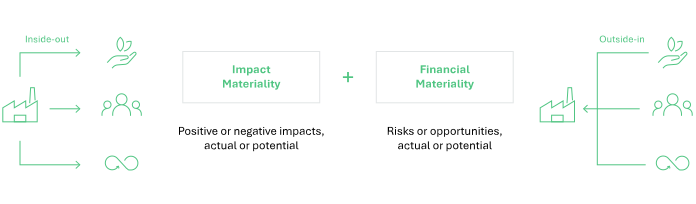
These are the topics that have emerged as priorities in Streparava’s vision and that of our stakeholders
| Area | Topic | Sub-topic |
|---|---|---|
Environment |
Climante Change (ESRS E1) |
|
| Resource use and circular economy (ESRS E5) |
|
|
Social |
Own workforce (ESRS S1) |
|
| Affected communities (ESRS S3) |
|
|
| Consumers and end-users (ESRS S4) |
|
|
Governance |
Business conduct (ESRS G1) |
|
The strategic Plan
The ESG Strategic Plan is the tool the Group uses to structure its vision of sustainability organically, by defining measurable objectives and concrete operating methods to achieve them. The plan is currently being drafted: the work initiated involved a thorough review of the company’s situation, followed by a structured internal discussion aimed at assessing the relevance and feasibility of potential areas of intervention. We have already identified some key objectives to focus on:
Environmental Objectives
Climate change
- Continue to improve energy management efficiency
- Increase adaptation to climate change
Use of resources and circular economy
- Continue to improve resource use efficiency
Social Objectives
Own workforce
- Continue to evolve the welfare and worker support system
- Continuously improve occupational health and safety management
Involved communities
- Continue and expand training local initiatives
Governance Objectives
Business conduct
- Promote greater harmonization among Group companies, enhancing the specific characteristics of each entity
- Increase adaptation to climate change
- Continue to raise awareness and knowledge of ESG issues
“We put our people at the center of everything we do: our approach and the way we experience the organization we believe in are based on our corporate values and their continuous promotion.”
